
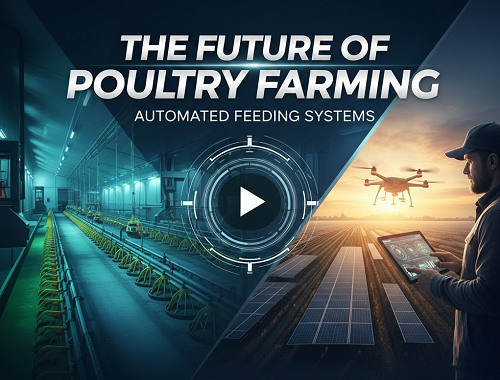
The Evolution of Poultry Farming: Why Automatic Feeding Systems are Essential
The global poultry industry is undergoing a massive shift towards smart farming. To remain competitive in the international market, farm owners are moving away from traditional methods and embracing Automatic Poultry Feeding Systems. This transition isn’t just about convenience; it’s about ROI, precision, and bird welfare.
1. Precision Nutrition and Uniform Growth
In large-scale commercial poultry operations, uniform growth is the key to profitability. With manual feeding, dominant birds often consume more, leading to uneven weight distribution. Automatic auger-based systems ensure that every bird, from the beginning to the end of the line, receives the exact same nutrient-balanced feed simultaneously.
2. Drastic Reduction in Feed Wastage
Feed accounts for nearly 70% of the total production cost in poultry farming. Manual troughs are prone to spilling and contamination. International-grade automatic feeders are designed with “anti-spill” rims and sensor-controlled dispensers.
-
Fact: Transitioning to automation can reduce feed wastage by up to 12%, significantly boosting your bottom line.
3. Enhancing Bio-Security (The International Standard)
Disease outbreaks like Avian Influenza can devastate a business. The more human interaction there is inside a shed, the higher the risk of pathogen entry. Automatic systems minimize the need for labor inside the pens, creating a sterile and controlled environment that meets Global GAP (Good Agricultural Practices) standards.
4. Labor Efficiency and Scalability
In many countries, labor costs are rising. An automated system allows a single operator to manage a farm of 50,000+ birds with ease. This scalability is vital for exporters and large-scale suppliers who need to maintain consistent output without increasing overheads.
5. Durability and Tech Integration
Modern equipment is now built using hot-dip galvanized steel and high-density UV-resistant plastics. These materials are designed to withstand the harsh ammonia-rich environment of a poultry house. Furthermore, these systems can now be integrated with mobile apps, allowing farm managers to monitor feed levels from anywhere in the world.
