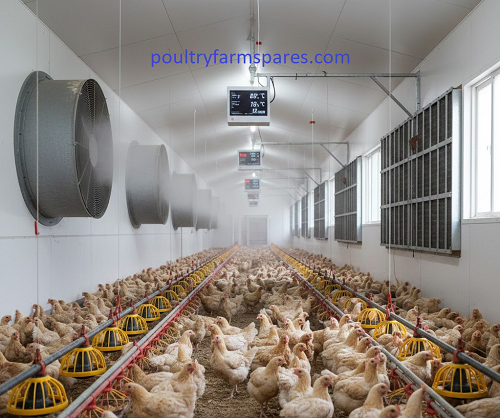
Why Tunnel Ventilation is a Game-Changer for Broilers
Broiler farming has evolved rapidly in recent decades, with producers constantly seeking ways to maximize growth rates, improve feed efficiency, and maintain flock health. Among the many technological advancements, tunnel ventilation systems stand out as a true game-changer. By creating a controlled airflow environment, tunnel ventilation addresses one of the biggest challenges in poultry production: maintaining the right temperature and air quality inside large-scale broiler houses.
This article explores why tunnel ventilation is essential, how it works, and the benefits it delivers for both farmers and poultry equipment suppliers.
What is Tunnel Ventilation?
Tunnel ventilation is a mechanical system designed to move air efficiently through a broiler house.
• Exhaust fans are installed on one end of the house.
• The fans create negative pressure, pulling fresh air through the inlets and across the length of the house.
• This airflow mimics a “wind tunnel,” cooling birds and removing excess heat, moisture, dust, and harmful gases.
By simulating natural breezes, tunnel ventilation ensures broilers remain comfortable even in hot climates.
Key Benefits of Tunnel Ventilation
1. Heat Stress Reduction
• Broilers are highly sensitive to heat.
• Tunnel ventilation lowers internal temperatures by several degrees, preventing heat-related mortality.
• Reduced stress leads to better feed intake and weight gain.
2. Improved Air Quality
• Removes ammonia, carbon dioxide, and dust.
• Ensures healthier flocks with stronger immune systems.
3. Enhanced Feed Conversion Ratio (FCR)
• Birds in well-ventilated houses convert feed into body mass more efficiently.
• Lower FCR means reduced feed costs, which account for up to 70% of production expenses.
4. Uniform Growth
• Consistent airflow ensures even temperature distribution.
• Results in uniform flock size, which is critical for processing efficiency.
5. Higher Productivity and Profitability
• Better growth rates and lower mortality translate into higher yields.
• Farmers achieve more kilograms of meat per square meter.
• Equipment suppliers can position tunnel ventilation as a profit-maximizing solution.
Tunnel Ventilation vs. Traditional Ventilation
Aspect Traditional Ventilation Tunnel Ventilation
Cooling Efficiency Limited, relies on natural airflow High, mimics wind tunnel effect
Air Quality Uneven, risk of ammonia buildup Consistent removal of harmful gases
Bird Welfare Higher risk of heat stress Comfortable environment, reduced stress
Growth Performance Uneven flock sizes Uniform growth and better FCR
Profitability Moderate Significantly higher